Dizziness before the next call
Nora turns up a quiet customer, then the next call strikes at a much higher level. Her ear aches and rings. She feels briefly nauseated and steadies herself against the desk before answering again. She reports the sudden change and notes which system, headset, and volume setting were in use.
After that reported loud call, Nora begins feeling dizzy and nauseated before her next shift - before she puts on the headset. She hesitates to wear it, loses her place in a customer record, and worries about making an error. More strain follows, and she dreads the next call. The cycle in the illustration begins with these real anticipatory symptoms; it does not require a new sound event at each turn. Nora records their timing, asks the employer to check the reported sound problem, and seeks an assessment of the ear and balance signs. Calling the entire sequence “stress” would miss what happened first.
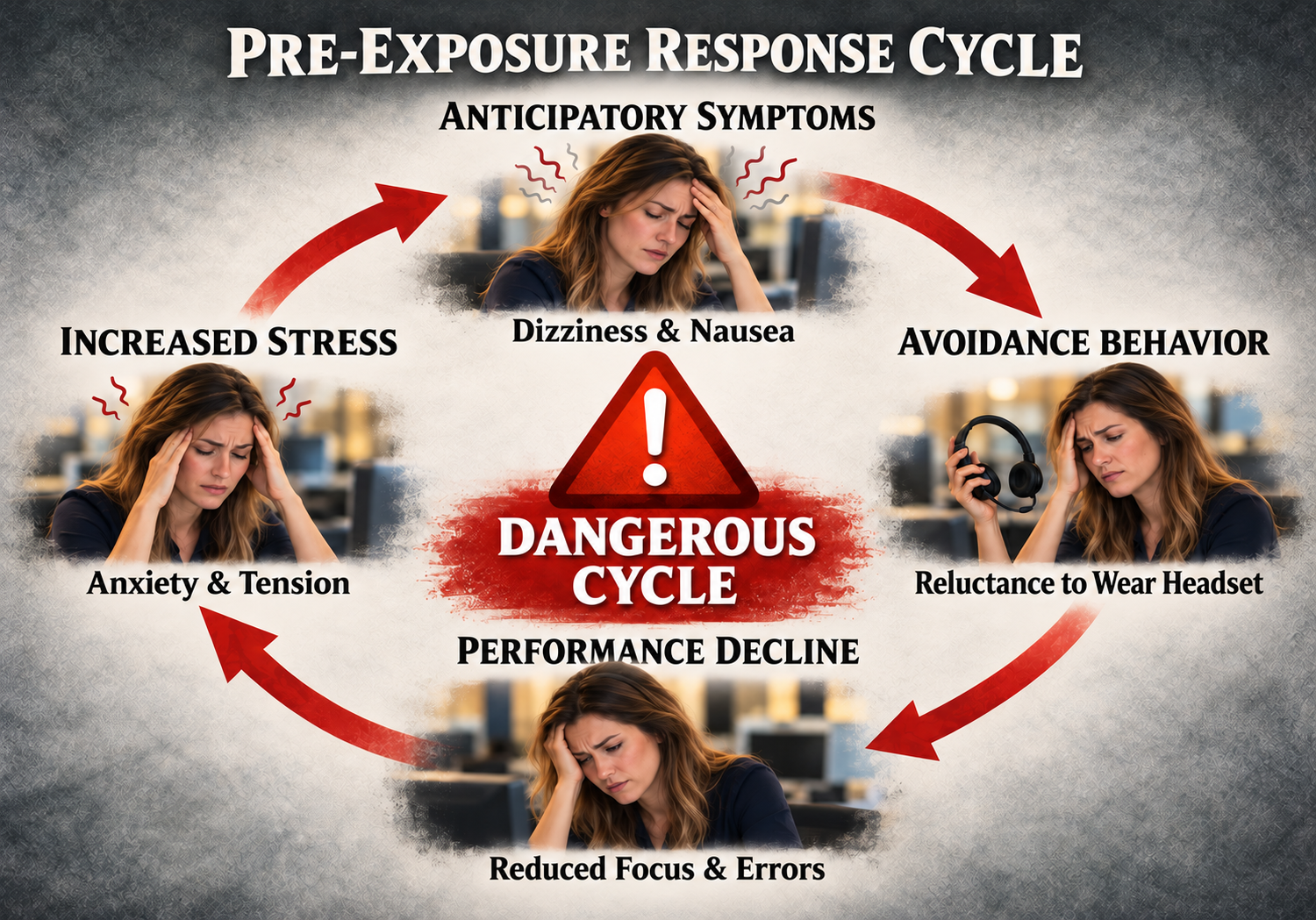
an Indian comparison of 30 full-time call workers with 30 controls (Verma et al., 2023) found hearing-test differences between full-time call workers and controls. NIOSH guidance for call and dispatch centers (National Institute for Occupational Safety and Health, 2011) documents abrupt changes in headset levels and reports of ear and balance symptoms after acoustic incidents. Nora’s ringing, dizziness, reluctance to wear the headset, and trouble focusing warrant a response that addresses both equipment and health.
Nora logs the unexpectedly loud caller at its exact time and separately looks at the less visible sound exposure over the whole queue. Assess call-to-call peaks and accumulated listening together; one measured average does not describe both. For U.S. workplaces, the U.S. NIOSH recommendation (National Institute for Occupational Safety and Health, 2026) is 85 dB(A) over eight hours and the U.S. OSHA limit (Occupational Safety and Health Administration, n.d.) is 90 dB(A) over eight hours (with hearing-conservation action at 85 dB(A)). The WHO–ITU safe-listening guidance for personal audio devices (World Health Organization & International Telecommunication Union, 2019) uses a more cautious 80 dB(A) over 40 hours per week for adults using personal audio devices. The figures give the team concrete comparisons for a measured sound exposure; the clinical assessment addresses the symptoms.
What changed after the loud call, and what happens even before the next one?
For research context, read the pathophysiology monograph. To prepare for a conversation with a clinician, use the documentation guide.