Skip to content
ESVI Group International Who we are › Customer service representatives
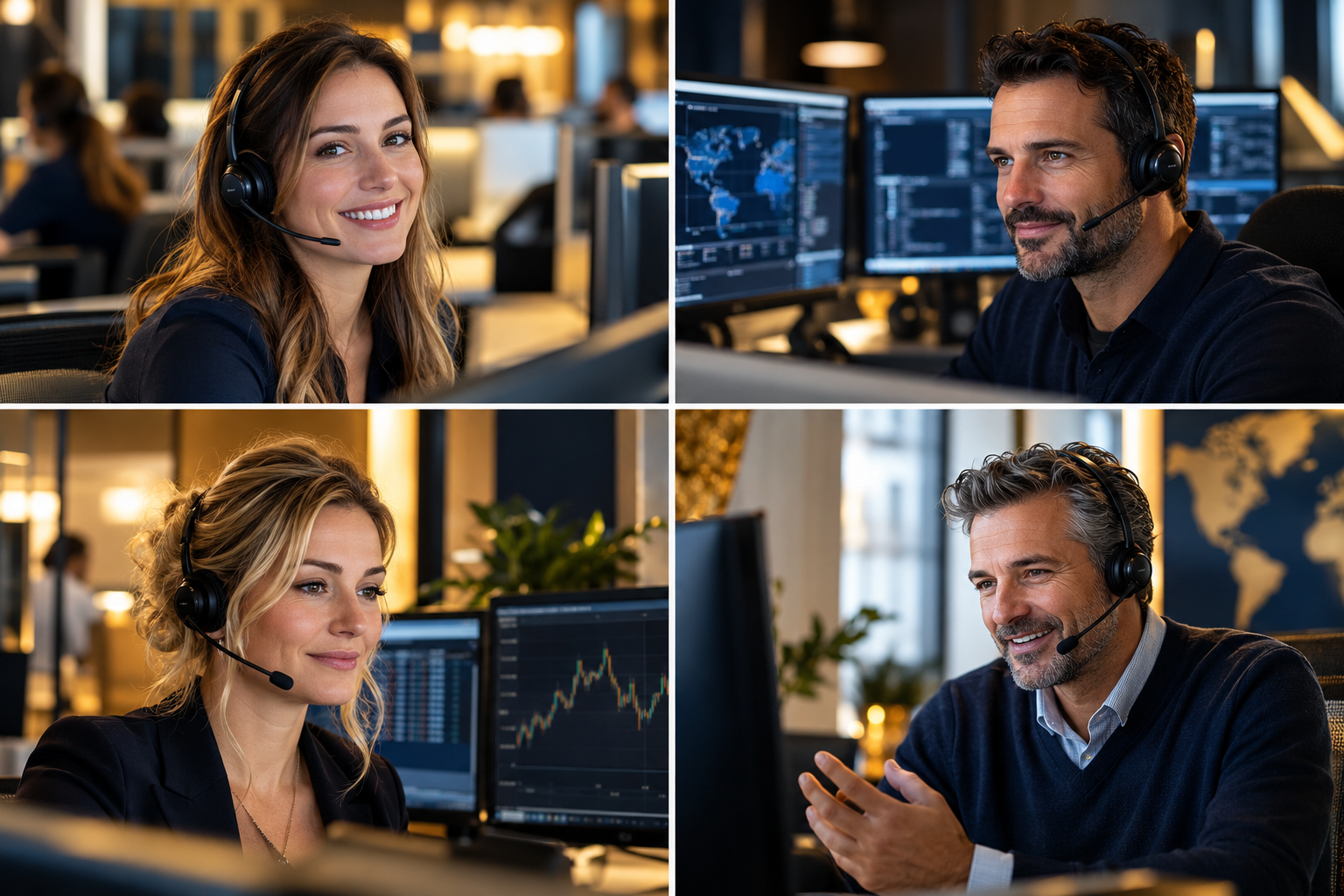
Four fictional customer service representatives wearing headsets at computer workstations.
Illustration. The people shown are fictional.

Headset-mediated · Customer service

The customer service representative

Eight hours on calls, often from a home office. The queue never empties, a supervisor can listen in, and the household or the caller's background makes it hard to hear, so the volume goes up. When the ringing and the headache follow her off the clock, she is told it is stress, or that she is burning out. These four panels follow that sound from the call queue into the ear, and out into how it gets misread.

WHY THE VOLUME GOES UP Background noisethe room, the house,the caller's line Speech is hardto hear Headset volumeturned up Every spikearrives louder:tones, feedback, shouting What keeps the volume safe Volume at or below the midpoint for an 8-hour day A headset with a limiter that blocks sudden peaks A quiet place to work, and breaks away from the headset Federal guidance for call and dispatch centers (National Institute for Occupational Safety and Health, 2011)
Mechanism drawn from federal guidance and listening research; not a measurement of any one worker. Open diagram full size

Panel 01 · The volume

The queue never stops

The United States employed 2,911,290 customer service representatives in May 2025 (U.S. Bureau of Labor Statistics, 2026c), and 64.8% of them are women (U.S. Bureau of Labor Statistics, 2026b). Representatives may be under pressure to answer a set number of calls while supervisors monitor them, and working from home is common (U.S. Bureau of Labor Statistics, 2026a).

Background noise at the workstation or on the caller's line may cause workers to turn the headset up, producing sudden increases in sound level (National Institute for Occupational Safety and Health, 2011). Listeners choose louder headphone levels in background noise than in quiet (Hodgetts et al., 2007).

Unknown. No published study has measured headset sound in home-based customer service agents. In the only published home-agent case, a worker developed noise-induced hearing loss after 50 months, and the employer did not allow the sound to be measured (Beyan et al., 2016). In laboratory tests, 4 of 12 headsets sold for remote work exceeded 85 decibels at full volume (Kozlowski, 2022). Search of PubMed, Europe PMC, and OpenAlex, November 8, 2026.

1 of 4

The ask

Turn it down, then write it down.

Keep the volume at or below the midpoint (National Institute for Occupational Safety and Health, 2011). Log each loud tone, feedback squeal, or shouting caller with the time and what followed, and note whether symptoms ease on days off. Ask the employer for a headset with a limiter, and ask your clinician for a hearing test and, if dizziness is present, balance testing.

Individual stories

The people and scenes are fictional illustrations of questions worth asking.

Noracustomer care agent · Dizziness before the next call →Benveteran · former helicopter crew · technical support · The helicopter, the headset, and the short fuse →Clairebilling specialist · Moving text, missed by a label →Owentravel service representative · Ringing and vertigo after a shift →

References

  1. Americans with Disabilities Act of 1990, 42 U.S.C. § 12102 (2008). https://www.law.cornell.edu/uscode/text/42/12102
  2. Ayugi, J., Nyandusi, M., Loyal, P. K., Mugwe, P., & Irungu, C. (2016). Acoustic shock syndrome in a large call center. International Research Journal of Basic and Clinical Studies, 4(1), 1–4. https://www.interesjournals.org/articles/Acoustic-shock-syndrome-in-a-large-call-center.pdf
  3. Beyan, A. C., Demiral, Y., Cimrin, A. H., & Ergor, A. (2016). Call centers and noise-induced hearing loss. Noise & Health, 18(81), 113–116. https://doi.org/10.4103/1463-1741.178512
  4. Hodgetts, W. E., Rieger, J. M., & Szarko, R. A. (2007). The effects of listening environment and earphone style on preferred listening levels of normal hearing adults using an MP3 player. Ear and Hearing, 28(3). https://doi.org/10.1097/AUD.0b013e3180479399
  5. Kozlowski, E. (2022). Noise parameters of headsets designed for communication platforms. International Journal of Environmental Research and Public Health, 19(6), Article 3369. https://doi.org/10.3390/ijerph19063369
  6. Nair, C. B., Nayak, S., Maruthy, S., Krishnan, J. B., & Devadas, U. (2024). Prevalence of voice problems, self-reported vocal symptoms and associated risk factors in call center operators (CCOs): A systematic review. Journal of Voice, 38(1), 245.e1–245.e15. https://doi.org/10.1016/j.jvoice.2021.07.022
  7. National Institute for Occupational Safety and Health. (2011). Workplace solutions: Reducing noise hazards for call and dispatch center operators (DHHS [NIOSH] Publication No. 2011-210). https://www.cdc.gov/niosh/docs/wp-solutions/2011-210/pdfs/2011-210.pdf
  8. Occupational Safety and Health Administration. (n.d.). Occupational noise exposure (29 CFR 1910.95). https://www.law.cornell.edu/cfr/text/29/1910.95
  9. Patel, J. A., & Broughton, K. (2002). Assessment of the noise exposure of call centre operators. The Annals of Occupational Hygiene, 46(8), 653–661. https://doi.org/10.1093/annhyg/mef091
  10. Pawlaczyk-Łuszczyńska, M., Dudarewicz, A., Zaborowski, K., & Zamojska-Daniszewska, M. (2022). Noise exposure and hearing status among employees using communication headsets. International Journal of Occupational Medicine and Environmental Health, 35(5), 585–614. https://doaj.org/article/8de01d7e9d224854b7aad37c1b9eaeee
  11. Pawlaczyk-Łuszczyńska, M., Dudarewicz, A., Zamojska-Daniszewska, M., Rutkowska-Kaczmarek, P., & Zaborowski, K. (2017). Noise exposure and hearing threshold levels in call center operators [Conference paper]. 12th International Congress on Noise as a Public Health Problem. https://www.icben.org/2017/ICBEN%202017%20Papers/SubjectArea01_Pawlaczyk-Luszczynska_0112_3664.pdf
  12. Pawlaczyk-Łuszczyńska, M., Dudarewicz, A., Zamojska-Daniszewska, M., Zaborowski, K., & Rutkowska-Kaczmarek, P. (2018). Noise exposure and hearing status among call center operators. Noise & Health, 20(96), 178–189. https://pubmed.ncbi.nlm.nih.gov/30516171/
  13. Silva, B. G., Gonzaga, D., Rocha, C. H., Gomes, R. F., Moreira, R. R., Bistafa, S. R., & Samelli, A. G. (2022). Noise exposure, headsets, and auditory and nonauditory symptoms in call center operators. American Journal of Audiology, 31(1), 112–125. https://doi.org/10.1044/2021_AJA-21-00088
  14. Sprigg, C. A., Smith, P. R., & Jackson, P. R. (2003). Psychosocial risk factors in call centres: An evaluation of work design and well-being (Research Report 169). Health and Safety Executive. https://www.alanbradshaw.uk/uploads/2/7/0/6/2706840/call_centre_psychosocial_risk_factors.pdf
  15. U.S. Bureau of Labor Statistics. (2026a). Customer service representatives. In Occupational outlook handbook. https://www.bls.gov/ooh/office-and-administrative-support/customer-service-representatives.htm
  16. U.S. Bureau of Labor Statistics. (2026b). Employed persons by detailed occupation, sex, race, and Hispanic or Latino ethnicity (Current Population Survey Table 11, 2025 annual averages). https://www.bls.gov/cps/cpsaat11.pdf
  17. U.S. Bureau of Labor Statistics. (2026c, May 15). Occupational employment and wages, May 2025 [News release]. https://www.bls.gov/news.release/pdf/ocwage.pdf

This page is for education and documentation. It does not diagnose any condition or give legal advice. A worker with ringing in the ears, dizziness, or headache should be evaluated by a licensed clinician.